Fusion 360 Vs Inventor
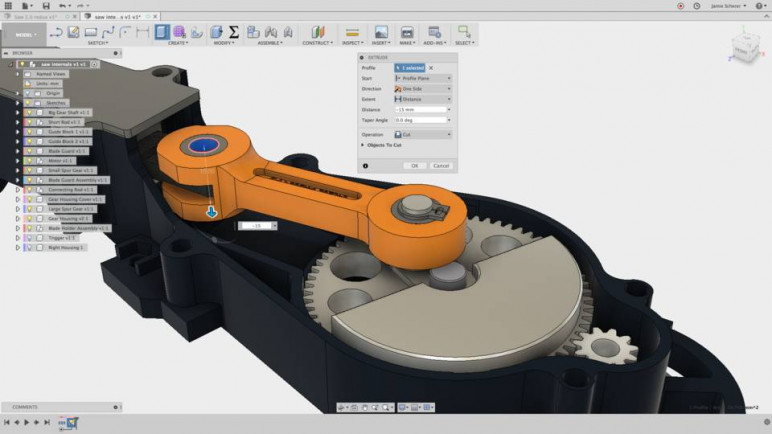
Hazelhoff: My team had a meeting with Autodesk yesterday and they were really pushing Fusion 360. We have been using Inventor Professional for a couple years now, mainly because the engineering class at our high school teaches it.
So my question is; what are the main differences between the two and would it be worth the switch next year? My main thing against fusion 360 is the lack of the constraint commands. I’m fusion you can only joint parts. The thing that fusion does have on inventor is accessibility, being able to get i to a project that you worked on at school, at home is a benefit. That feature can be achieved with programs like grabcad. Other than that the two programs are pretty similar, with that being said after trying fusion I definitely prefer inventor.
Good luck and CAD on! Autodesk is really putting a ton of resources behind Fusion, with the ultimate goal of claiming back market share from Solidworks. All the newest updates are coming for Fusion first, and it’s a recommended download on the Inventor download page. I’ve been told that at some point in the not-too-distant future, Inventor will be no more, and everything will be in Fusion. I find Inventor to be a mature, professional, enterprise-class product.
It’s been around for 20 years. Fusion has come a long way in the last 2 years, but does not match the mature “feel” of Inventor. Also with Fusion, you do not choose your updates, Autodesk chooses for you. You may launch your software one day, and something is totally different from yesterday, which is super annoying.
Also, I much prefer the hierarchical tree of the Inventor browser to the Fusion feature timeline which I find to be confusing. That said, both softwares essentially do the same things now.
Data management is different. In Inventor, you have the option of running Vault. And if you run Vault on Amazon EC2, that’s the hot ticket and is fabulous. In Fusion, you get the Autodesk cloud backend, which can be a little flaky, but is getting better.
However, there is no PDM checkin/checkout workflow yet for Fusion. Long story short, like it or not, Fusion is the way of the future, and you can either jump aboard the train or watch it pass you. For now, I’m choosing the latter. Sanddrag: Long story short, like it or not, Fusion is the way of the future, and you can either jump aboard the train or watch it pass you. For now, I’m choosing the latter. This is the tech world. We can choose a different train;).
One plus for Fusion is having it on a tablet in the shop. One of our mentors has a cheap one and uses it to verify measurements, assemblies, etc, without going back-and-forth multiple times. Personally I do not like auto-updating software. If it updates in the middle of build season and totally screws with our process or models, the entire software suite would be worthless.
It’s the same thing with building software for production. Don’t accept update to dependencies right before production release. Having used Inventor for years I’m somewhat biased, but I tried to use Fusion 360 once when I needed some CAM software (before I found out about HSM), I got so frustrated with the non-intuitive controls that I eventually just gave up and uninstalled it.
You also cannot import native Inventor models to it (which seems insane to me given they do basically the same thing and are made by the same company). There are of course some advantages (and disadvantages) to having everything cloud-based, but personally I find Inventor to be much easier to use and a much more powerful tool overall. Tangert: So while the debate of what CAD system is the best continues to rage on, my larger question is has anyone used Fusion 360 to design an entire FRC bot? As lead (only) designer for 1155’s robot this year, I can attest that yes, someone (me) has designed an entire FRC bot entirely on Fusion. Let me talk for a bit about my experience.
100% I love how they have done cloud integration. It absolutely promotes collaboration and is great at keeping all of your previous revisions (more than once I had to revert because a rookie decided to experiment using THE MAIN ROBOT FILE). If there is any one reason to use Fusion, this is it.
No hassle, works like it should, and keeps everything safe. Autodesk is throwing tons of money at the program right now, meaning you have an extremely active and supportive development team. There are constantly new tutorials coming out on YouTube and plenty of help on the forums. And yes this means they are pushing updates constantly but I never had that interfere with my design at all during build. In terms of potential, I think Fusion has the potential to be a better CAD program than solidworks or inventor will ever be. But it might not be there yet. Is it good enough for FRC?
Will it annoy the $#!+ out of you at times because a certain feature you expected to be there isn’t yet and as a result you need to take a roundabout method to accomplish your goal? Also definitely. So the million dollar question: do you make the switch? Obviously for my team the answer was yes.
Cloud integration and active support outweighed the inconveniences. For others, I honestly think it is a matter of time before we are all forced to switch, either by shutting down inventor or by Fusion totally eclipsing inventor in every way. There is little doubt that Fusion is the CAD program of the future. The real question is when you bite the bullet and leave behind the comfort of inventor.
I know our team is actively investigating switching to Fusion from SolidWorks because of the cloud features. Right now, only students who have their “own” computers can work on CAD, or it can only be done on our single computer at the lab.
Given that our school gives every student a Macbook Air, switching to Fusion would allow anyone to contribute or view what is going on we think. Still checking it out. It seems one hurdle is going to be signing up for all of these individual licenses instead of one large block.
Guniv: We don’t, sadly. Hence I think we have to wait for them to approve every single person, as far as I understand.
I just remade my account to check, it took about 10 minutes and I was downloading Fusion. Link to get started quickly is. This year I was also the CAD leader, and worked with another student and one of our sponsors to design our robot in Fusion this year.
The sharing was incredibly helpful, and the web interface is really good for sharing designs with teammates who don’t have an account. Fusion also recently released an update that allows there to be multiple parallel iterations of a project, similar to branches on github, which has a lot of potential as my team grow larger. The customer support through the forums is also great. During the season a small feature was removed in an update which affected my workflow. I posted a complaint to the forum and within a couple days the feature was patched back in. There are definitely a lot of features such sheet metal design tools that are not currently implemented, but updates come out constantly, and the integration from CAD to CAM is great.
Nikita S.: Fusion360 doesn’t allow you to create interactive assemblies. You can only mate or joint parts; there are no other types of constraints. It’s probably because Fusion is primarily meant for product design.
Fusion does have other useful features, (simulations, rendering, etc.) but it turns out that Inventor has the same things. Inventor also has drawing and presentation features that don’t exist in Fusion. In essence, Inventor can do anything Fusion can do and more.
You can do interactive sliders and rotational stuff, it doesn’t have some of the more advanced stuff but what’s available is sufficient for FRC. Inventor doesn’t have the primary feature of Fusion, cloud based storage and collaboration. It also doesn’t have native Mac Support.
Nor does it have native CAM functionality Realistically for a.FRC team. Fusion 360 is plenty sufficient for 99% of everything we do. Don’t kid yourself, the CAD we do for FRC is simple relative to the use cases these products are designed for. It’s not about what software has the most features but how well those features work for your team.
What if I told you I've been using a CAD software that was faster and more flexible than SolidWorks, ran both on a Mac and PC and cost zero dollars? Would you believe me? Two months ago, I began using Fusion 360, Autodesk's cloud-based CAD software. Since then, I've been asked to compare Fusion 360 to SolidWorks more than a dozen times. Being an on-again, off-again user of SolidWorks since 2010, I figured I knew enough about the two programs that I'd be able to do a rudimentary comparison. While I'm doing my best to keep this article completely factual, I'd say I'm an average user of both Fusion 360 and SolidWorks at best. Please let me know if I make any glaringly erroneous statements.
UPDATE (3/12/2017): It looks like SolidProfessor is now charging to access all the Fusion 360 tutorials, however they seem to still be available for free at the Fusion 360 website: What is Fusion 360? Fusion 360 is a cloud-based parametric solid-modeler that offers features to get you from idea to prototype in one single environment.
Below, you'll find the different modes and what they're used for. Model - Parametric Solid Modeling. Patch - Surface Modeling. Render - Real-time Ray Tracing. Animation - Timeline & Animations. Simulation - Validate & Optimize Designs. CAM - Manufacturing Fusion 360 vs.
 Wireless (Wi-Fi) Connection Setup Guide for PIXMA MG3640. For Windows users, insert the CD that came with your printer & run the setup. If you do not have. [MASTER] Picture_PIXMA Wireless Connection Setup Page tab 1-1. Insert the CD that came with your printer and run the setup. Otherwise click on [No]. WPS Connection Method. Make sure that the printer is turned on. Press & hold the [Wi-Fi] button on the top of the printer until the alarm lamp flashes once. Make sure that the lamp next to this button starts to flash blue and then go to your access point and press the [WPS] button within 2 minutes.
SolidWorks Realize now that a comprehensive comparison is not going to happen. It would be exhausting and it's beyond the scope of my knowledge. I've settled on a shootout-style feature comparison based upon what I see as potential deal-breakers when deciding which software to invest resources in learning. As a 3D Artist with an industrial design background, I use both SolidWorks and Fusion 360 for solid modeling and surface modeling occasionally. Though both SolidWorks and Fusion 360 offer features beyond solid modeling, I won't be getting into those in this article.
Part/Assembly Mode - When you begin a new design in Fusion 360, you don't specify whether you're creating a new part or assembly as you do in SolidWorks. In Fusion 360, once you've got Fusion Design files and they can all have multiple bodies, components and subassemblies. Later down the line, Fusion's flexibility becomes more apparent when you don't run into the myriad reference issues that can arise when building top-down assemblies in SolidWorks. Fusion 360 - 1, SolidWorks - 0. User Interface pt.
1 - Fusion 360, has a very simple UI (user interface), reminding me a bit of Google's Sketchup. Fusion 360 has a few bold icons and the entire working area (called the canvas) only shows a grid where you're working, allowing you to focus on what you're creating. When I've the luxury of working behind a large monitor, I prefer to see every button laid out in plain view. However, I travel frequently for work with a 15' Macbook Pro, and the consolidated tools and condensed menus make working on a laptop pleasant. One way this is achieved is by allowing commands to perform several functions. For instance, in Fusion, the same extrude command can create a new body, component, extruded cut or intersection. This Swiss Army knife functionality applies to nearly every tool in Fusion 360!
Fusion 360 - 2, SolidWorks - 0. User Interface pt. 2 - I've got more to say about the UI. Many programs offer flexible, customizable UIs. Take Adobe for instance. Additionally, they've gone to a dark theme reducing contrast (strain on eyes) as well as offering tool menus that don't compete with the work you're creating.
Fusion allows you to change your canvas to one of five presets, some darker and some lighter. Other than hiding some menus, I don't think the Fusion tool menus can be customized. SolidWorks 2016 has some Dark, Medium and Light workspace presets (though they still need some work in my opinion). If you spend countless hours behind an LED monitor every day, or work through the night in a dark room, having control over the UI is very important. Though neither are great, SolidWorks one-ups Fusion 360 here.
Fusion - 2, SolidWorks - 1. User Interface pt. 3 - The last bit about the UI I'd like to address is about efficiency. If power users were wizards, then consider hot keys, scripts, macros and programmable commands their magic spells. In SolidWorks, I take advantage of a fully-programmable keyboard, 21 button mouse and programmable mouse gestures. In Fusion 360's, there are a handful of predefined hot keys and that's it. The Modeling Toolbox does speed things up by allowing you to search for commands and then 'promote' them to the toolbox putting them a keystroke and click away.

I still think SolidWorks reduces keystrokes and clicks better which is why it wins here. Fusion360- 2, SolidWorks - 2. Feature Tree - Since Fusion 360 is a parametric modeler, it offers a nice feature tree like SolidWorks does but in this case, it's located along the bottom of the workspace. The wider your monitor is, the more it makes sense. However, I find it very difficult to quickly locate certain features. Once your feature list becomes longer than your monitor is wide, you need to scroll back and forth to locate a given feature.
When clicking on a geometry or feature in the canvas, three little marks appear above the associated feature in the tree. I'd prefer that visual queue be easier to see as well as snap that feature to the center of the Feature Tree reducing the time spent locating a feature. SolidWorks does this a bit better. Because the feature tree items take up less space in SolidWorks and are highlighted in blue when the corresponding geometry is clicked in the workspace, I find it faster to locate a feature within SolidWorks. Fusion 360 - 2, SolidWorks - 3. Sketch Tools - Sketching in Fusion 360 is very similar to SolidWorks. Fusion 360 is quite good at adding automatic constraints and relations to sketches as you work.
Also, sketch constraints can be added in Fusion faster than they can in SolidWorks as the tool stays active until you choose to terminate it. Unfortunately, I've got a nit to pick with how sketches are used in Fusion. In SolidWorks, I can keep most of my sketches on the global X,Y and Z planes then start or terminate a feature from places other than that sketch plane. A feature in SolidWorks can be started from other planes, an offset distance or a vertex as well as terminated with those same parameters.
From what I've seen in Fusion 360, you need a plane with a sketch on it in the exact location you want a feature to originate. This one's a draw.
Fusion 360 - 3, SolidWorks - 4 Modeling Tools pt. 1 - Fusion is very robust in this arena.
Fusion 360 Vs Inventor Lt
Though everything is pretty much sketch-driven, the act of solid modeling feels a bit simpler and quicker in Fusion. One simple feature called Press/Pull allows for any face or surface to be well, pushed or pulled. SolidWorks has it's Instant3D, which is similar, but not quite as flexible.
Fusion 360 Free For Hobbyists
For example, if you invoke Press/Pull and select an edge, it'll automatically fillet the edge and offer a few parameters you can adjust before accepting the change. Fusion 360 - 4, SolidWorks - 4 Modeling Tools pt. 2 - Let's discuss fillets, loved and hated by many. They're often abused and with that surface continuity discarded. However, for many industrial or concept designers, a fillet is a quick solution to describe form and thus speeds up workflow. Fusion 360 handles lots of complex fillet scenarios with ease and speed.
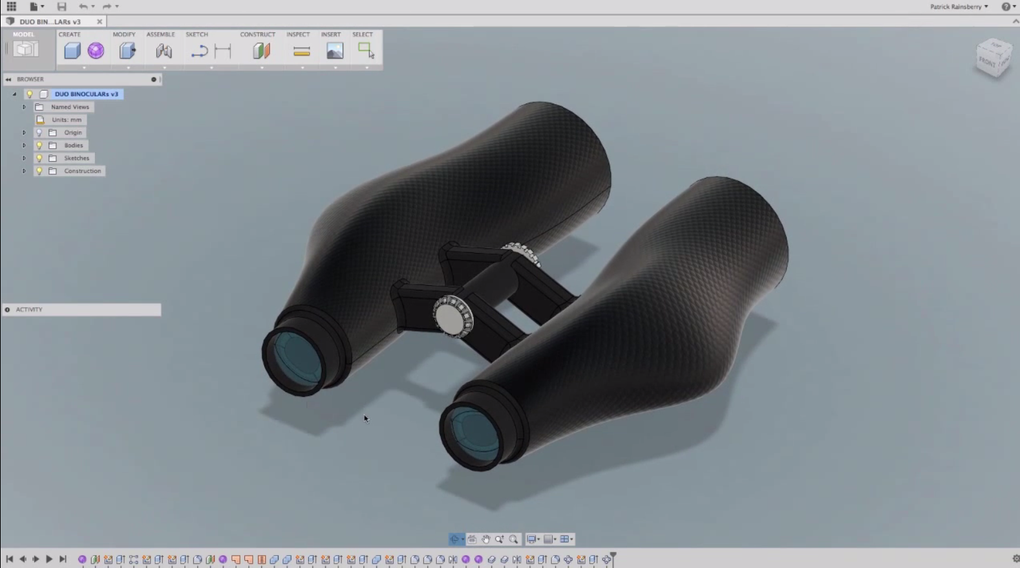
It's got an option to preserve surface continuity with a handy 'G2' checkbox. It offers a few fillet types and they generally work. You can also add some impressively large fillets to fake the blending of two surfaces if the G2 checkbox is left unchecked.
However, I've got to say that SolidWorks offers more control over fillets and with SolidWorks 2016 offering a curvature continuous fillet, it wins in the feature-rich fillet department. However, since Fusion seems to handle the fillets faster and more consistently, I have to say this one is also a draw.
Fusion360- 5, SolidWorks - 5 Modeling Tools pt. 3 - Construction Geometry bears discussion.
In SolidWorks, a fair amount of time is spent creating planes and sketches just to use to create sketches to create geometry. (Llike a bad sequel to Inception) SolidWorks allows you to add a plane and then constrain it using dimensions and relations. Fusion went a different route and offers a whole pallet of construction geometry specific for common scenarios, making it quicker to set these up.
Nice work, Autodesk! Fusion 360 - 6, SolidWorks - 5. Modeling Tools pt. 4 - Fusion 360 has a unique feature that it automatically gets points for no matter what since SolidWorks doesn't offer it at all-Sculpt mode. This is a T-Splines based method of modeling. (Think T-splines for Rhino) It allows some aspects of polygonal modeling to be integrated with NURBS techniques, which is what CAD applications use. While sculpting in Fusion 360, you are able to retain surface curvature and push and pull your way to more organic shapes.
This makes modeling plastic housings for electronics much simpler. Some amount of parametric history is retained as you freeze your sculpted form to return to working in full NURBS/Model mode. Fusion 360 - 7, SolidWorks - 5. Price - I want to address accessibility. Autodesk is pushing really hard to get its software into the hands of students. Fusion 360 can be had for professionals for $40 per month or $300 per year. If you're a student, teacher or some other academic institution, you get a free three-year license.
And if that's not good enough, hobbyists, startups, makers all get a free one-year license so long as you're not generating over $100,000 in revenue as a direct result of using Fusion 360. The last time I was quoted for a single, node-locked license of SolidWorks, the figure was around $5,000 USD. Fusion 360 - 8, SolidWorks - 5. Operating System - I run Fusion 360 natively in the mac OS, which means Fusion 360 works beautifully in a mac environment. Whenever I use SolidWorks, I have to run it inside a virtual machine on Parallels. I've also had some issues that I think may be graphics card related when using SolidWorks in Parallels on the Macbook Pro.
I'll mention that Fusion 360 is a much smaller installation on your hard drive than SolidWorks is. I like that Fusion 360 offers a virtually identical experience on both Mac and Windows. The fact that Fusion 360 isn't tied to one OS means it wins here. Fusion 360- 9, SolidWorks - 5 Cloud Integration - The last major item I wanted to cover is that Fusion 360 is cloud-based. What does that mean?
The application runs locally on your machine, but your data is saved in Autodesk's cloud storage which is associated with your account. You can manage all your files and projects through the web-based interface.
I haven't dug too deep into it since I haven't collaborated with anyone on a Fusion 360 project yet. This feature makes sharing and documenting your design process a easier than allowing each collaborator to manage files his or herself. Fusion automatically saves versions of your files and helps with naming them appropriately and even saves standard views of each design, so you have a set of thumbnails to share or preview before opening them.
The best part of all this is the continuity it offers. I can work on a design from my PC at home, resume working on the Mac pro in the office and later when I'm on a flight, I can resume work from my Macbook pro. Wherever I am, I have access to my designs and the work experience is the same. This is one of my favorite aspects of Fusion 360 hands-down.
Fusion 360- 10, SolidWorks - 5. I honestly can't comment on the Patch, Animation, Simulation or CAM workspaces within Fusion 360 as I haven't a use for them yet or the time to explore them currently. Perhaps in a later article I can touch on these topics. Are you excited yet? In my comparison of features, Fusion pulls ahead quite a bit. If you agree with my assessment, you should. Before you shout at your monitor, 'I don't have time to try and learn all this stuff,' I want to share how I got comfortable in Fusion 360 in about a single week.
SolidProfessor.com produced a course of videos to take you from absolute beginner to respectable modeler in Fusion 360 for free! If you're anything like me though, and you value investing in your own skills and education, you'll see that SolidProfessor delivers in the value department. They have full video courses on a handful of 3D applications and make it easy to track your progress with tests and courses and bookmarks. Once you've downloaded your copy of Fusion 360, head over to and sign up for free and become a Fusion wizard!
Inventor Fusion 2013 Free Download
Finally, I'd like to leave you with some Fusion 360 resources that I've found helpful.